
High-Rise Window Cleaning: Drone vs. Scaffolding vs. Rope Access
The quote came back with a three-day setup window, a city permit for a street closure, and a note about taking the
front row of the parking lot offline for the duration. For the facility director of a 10-story Houston office tower, this was not unusual. It was simply how window cleaning worked.
Until it wasn't.
Over the past several years, commercial property managers have gained two viable alternatives to scaffolding: rope access and drone cleaning. Each method solves a different version of the problem. Each has real advantages and real limitations. And the honest answer to "which one should I use?" depends on your building, your timeline, your tenants, and your risk tolerance.
This post lays out all three methods side by side. Not a sales pitch disguised as a comparison. Just the information you need to make a good call.
In this guide:
- What each method is and how it works
- A factor-by-factor breakdown covering safety, speed, cost, and disruption
- When scaffolding is still the right choice
- When rope access makes sense
- When drone cleaning wins
- How to evaluate your building against each option
What Are the Three Methods?
Commercial high-rise window and facade cleaning is performed through three primary methods: scaffolding (fixed or suspended), rope access (also called industrial rope access or abseiling), and drone cleaning (remotely piloted aircraft with water delivery systems). Each method was designed for a different set of conditions, and each performs best within its ideal range.
Scaffolding
Scaffolding involves erecting a supported structure alongside the building exterior, either from the ground up (supported scaffolding) or suspended from the roof via swing stages. Workers operate at height from the scaffold platform. This method has been the industry standard for decades and remains the most widely used approach for complex or very tall facades.
Rope Access
Rope access uses certified technicians who descend the building using controlled rope systems anchored at the roof. Operators hang from the building and clean section by section. This method requires minimal equipment and no large scaffold structure, which makes it faster to deploy and less disruptive to the surrounding site. It is widely used in dense urban settings where street access is limited.
Drone Cleaning
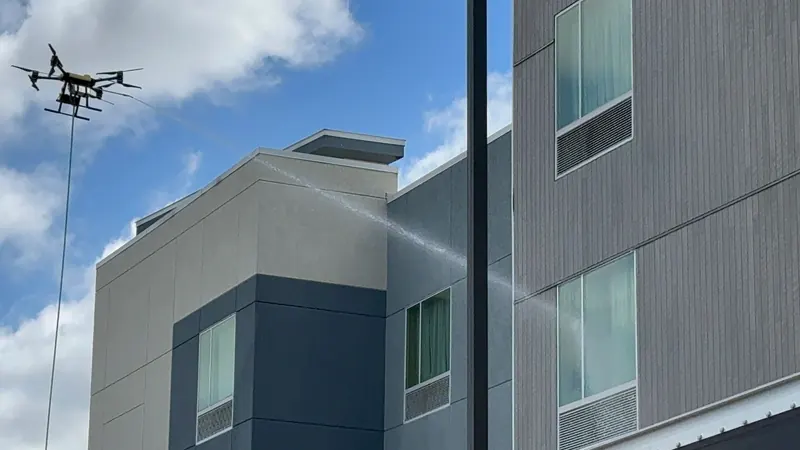
Drone cleaning uses a remotely piloted aircraft equipped with pure water delivery systems and soft cleaning attachments. A ground-based pilot operates the drone while a second crew member monitors water supply and flight performance. No one leaves the ground. The drone moves floor by floor across the building exterior under FAA Part 107 certified operation.
The Breakdown: Drone Cleaning, Scaffolding, and Rope Access
When comparing these three methods, the differences come down to five things: who is at height, how long setup takes, how much your site gets disrupted, what permits are needed, and which building types each method covers best. Here is how each one performs across those factors.
Setup time
- Drone cleaning: 15-20 minutes
- Scaffolding: 1-3 days
- Rope access: 2-4 hours
Workers at height
- Drone cleaning: Zero. The entire operation runs from the ground.
- Scaffolding: Multiple workers on the platform throughout the job.
- Rope access: Yes. Certified technicians descend from roof anchors.
Fall liability exposure
- Drone cleaning: None. No one is elevated at any point.
- Scaffolding: High. Multiple workers at height for extended periods.
- Rope access: Moderate. Mitigated by certifications, but workers are still elevated.
Site disruption
- Drone cleaning: Minimal. Equipment fits in 1-2 parking spaces with no street impact.
- Scaffolding: Significant. Often requires street closures, lane restrictions, and large staging areas.
- Rope access: Low to moderate. No scaffolding, but roof access and some ground staging required.
City permit required
- Drone cleaning: No. FAA airspace authorization applies, not a street permit.
- Scaffolding: Often yes, especially for buildings near public roads or sidewalks.
- Rope access: Usually no.
Effective building height
- Drone cleaning: Up to approximately 150 feet above ground level.
- Scaffolding: No height limit.
- Rope access: No height limit.
Roof anchor points required
- Drone cleaning: No.
- Scaffolding: No (for ground-supported configurations).
- Rope access: Yes. Permanent or temporary roof anchors must be in place.
Water system used
- Drone cleaning: Deionized or RO-purified water. No minerals. Streak-free results.
- Scaffolding: Tap or treated water, varies by contractor.
- Rope access: Tap or treated water, varies by contractor.
Weather dependency
- Drone cleaning: High. Wind and rain can ground flight operations.
- Scaffolding: Low. Work generally continues in most weather conditions.
- Rope access: Moderate. High wind affects rope stability and technician safety.
Best building type
- Drone cleaning: Mid-rise commercial buildings with open glass facades.
- Scaffolding: Very tall or geometrically complex facades requiring close manual access.
- Rope access: Narrow urban sites, spot repairs, and targeted cleaning sections.
Before-and-after documentation
- Drone cleaning: Standard on every FlyWash Drone job.
- Scaffolding: Varies by contractor.
- Rope access: Varies by contractor.
When Scaffolding Is Still the Right Call
Scaffolding earns its place when the job demands it.
For buildings above 20 stories where drone altitude limits apply, scaffolding or suspended stages give workers a stable platform at any height. For facade restoration work that requires physical contact alongside cleaning, including scraping, caulking, and sealant work, scaffolding provides the workspace and tool access that a drone cannot replicate.
Buildings with ornate masonry, deep window reveals, or complex architectural geometry that requires manual attention will often still benefit from scaffolding for those specific sections.
Where scaffolding loses ground is in routine maintenance cleaning on mid-rise commercial properties where the structure exists purely to transport workers up and down. When cleaning is the only task, scaffolding frequently becomes the most expensive and most disruptive way to accomplish it.
When Rope Access Makes Sense
Rope access is the specialist's tool for dense urban sites.
If your building sits in a tight downtown block with no room for scaffolding and no clear flight zone for a drone, rope access often becomes the practical answer. Technicians rappel down from the roof, clean in sections, and ascend. No street impact. No large equipment to stage.
Rope access also makes sense for targeted work: a specific floor with heavy staining, a section flagged after a building inspection, or a post-construction punch list item. The lower mobilization cost compared to scaffolding makes it practical for smaller-scope jobs.
The limitation is the same as scaffolding: workers are at height. OSHA fall statistics apply to rope access operations just as they do to scaffold work, even with the mitigations that certified rope access technicians use. Insurance exposure and safety documentation requirements remain.
When Drone Cleaning Wins
Drone cleaning performs at its best when the job is routine exterior cleaning on a mid-rise commercial building with open glass facades and standard site access. In that scenario, every factor in the breakdown above points to the same answer.
Setup takes 20 minutes instead of three days. The parking lot stays open. No street permit is filed. Tenants and guests never know the job is happening. Before-and-after photos document every surface cleaned. And the crew on site never files a workers' compensation claim related to a fall from height.
FlyWash Drone has completed commercial facade and window cleaning for Marriott Hotels, HCA Houston Healthcare, Saint John College, and Tanglewood Condominium. These are properties with real tenant and guest populations, active parking lots, and zero tolerance for operational disruption. The drone method fits that constraint set in a way that scaffolding and rope access don't.
For large industrial facilities where site access is restricted to credentialed workers, drone cleaning also holds a specific advantage. FlyWash holds TWIC authorization for unescorted access to refineries, maritime ports, and high-security industrial sites. Most scaffolding and rope access contractors cannot enter those environments at all.
What Affects Which Method Your Building Needs?
Four factors determine the right answer for most commercial properties.
1. Building height
Under 150 feet: drone cleaning covers the full building in a single mobilization. Over 150 feet: evaluate a hybrid approach, where drones clean the lower sections and rope access or suspended stages handle the upper floors. A site assessment determines the right split.
2. Facade geometry
Open glass curtain walls and standard commercial window grids are ideal for drone cleaning. Deep window reveals, projecting cornices, and complex ornamental surfaces may require closer manual contact in specific sections. If your facade has significant architectural complexity above the 6th floor, note it in your initial consultation.
3. Site constraints
If your property is in a tight downtown block where site geometry makes it difficult to maintain a clear operating zone, rope access may be the better fit for that specific building. A site assessment confirms which constraints are actually relevant before any method is recommended.
4. Scope of work
Cleaning only: drone cleaning or rope access. Cleaning plus physical repairs, caulking, or sealant work: scaffolding or rope access gives technicians the workspace and access they need. Mixed-scope jobs sometimes use a primary drone clean followed by targeted rope access for repair sections.
How to Get the Right Quote
Any legitimate contractor offering exterior building cleaning should be able to walk you through the right method for your property before a price is discussed. If a company quotes scaffolding for a 10-story building without offering alternatives, or quotes drone cleaning for a 30-story tower without addressing altitude limits, ask them to explain their reasoning.
For a drone cleaning assessment, FlyWash Drone reviews building height, facade type, site access, and the scope of work before recommending a method. In some cases, a hybrid approach is the right answer and we will say so rather than forcing every building into a single method.
The facade cleaning and window cleaning service pages cover what FlyWash handles across building types and heights. The assessment is free and includes a site-specific recommendation.
Scaffolding, rope access, and drone cleaning each have a place in commercial exterior maintenance. The question is not which method is best in general. The question is which method fits your building, your timeline, and your operational constraints.
For most mid-rise commercial properties in the 5-to-15-story range with standard glass facades, drone cleaning is the answer. Faster setup, less site disruption, no workers at height, and streak-free results from purified water systems. For very tall or complex facades, scaffolding remains the right tool. For tight urban sites or targeted repair work, rope access fills the gap.
If your property falls in the drone cleaning range and you want a direct recommendation based on your specific building, a free assessment is the place to start. Visit our services page or reach out directly.
Frequently Asked Questions
Is drone cleaning cheaper than scaffolding for a commercial building?
For routine mid-rise exterior cleaning, drone cleaning is typically less expensive than scaffolding when total project cost is considered. Scaffolding costs include equipment rental, assembly labor, city permits, and extended time on site. Drone cleaning eliminates most of those line items. The exact comparison depends on building size and scope. FlyWash Drone provides site-specific quotes at no charge so you can compare directly.
Can drones clean buildings taller than 10 stories?
Most commercial cleaning drones operate effectively up to around 150 feet above ground, which covers buildings in the 10-to-15-story range depending on floor-to-ceiling height. For taller buildings, a hybrid approach is used: drones clean the lower sections and rope access or suspended equipment handles the upper floors. A site assessment determines the best split for your specific building.
How long does drone window cleaning take compared to scaffolding?
Setup for a drone cleaning job takes 15 to 20 minutes. Setup for scaffolding on the same building typically takes one to three days, not counting city permit lead times. For a typical mid-rise commercial building, total time on site for drone cleaning is a few hours. The same building with scaffolding often runs multiple days.
Do I need to close streets or parking lots for drone window cleaning?
No. The drone cleaning crew and equipment fit in one or two parking spaces or a small sidewalk area. No street closures or lane restrictions are required. This is one of the primary reasons commercial property managers choose drone cleaning over scaffolding for occupied buildings with active tenants and guests.
What certifications should I require from any high-rise window cleaning contractor?
Regardless of method, always require FAA Part 107 certification for drone operators, a certificate of general liability insurance, and workers' compensation coverage for the crew. For rope access, require IRATA or SPRAT certification for technicians. For scaffolding, require OSHA compliance documentation and a licensed scaffold erector where local code requires it. FlyWash Drone carries all applicable certifications and credentials are available for review through the about page before any job begins.
Why FlyWash Drone
FlyWash Drone is a Houston-based exterior cleaning company serving commercial and industrial properties across Texas and the United States. Every job is operated by FAA Part 107 certified pilots with full general liability insurance. Certificates of insurance are available before work begins.
Beyond standard commercial properties, FlyWash holds TWIC authorization for unescorted access to refineries, maritime ports, and high-security industrial facilities. This credential opens sites that most exterior cleaning contractors cannot legally enter.
The company's client list includes Marriott Hotels, HCA Houston Healthcare, Saint John College, and Tanglewood Condominium. These are organizations with real operational and safety standards, and ongoing service relationships built on consistent, documented performance.
Whether you are comparing methods for the first time or looking for an alternative to a scaffolding quote, the assessment starts with a conversation. Visit the services overview or reach out directly.
Ready to find out which method is right for your building?
FlyWash Drone provides free site assessments for commercial and industrial properties across Texas and nationwide. No scaffolding, no street closures, no workers at height. Tell us about your property and we will tell you whether drone cleaning is the right fit.
Request a Free Assessment | View All Services
Call us: 1-877-FLY-WASH (1-877-359-9274)